

What does the organization do? What is its major work activity?
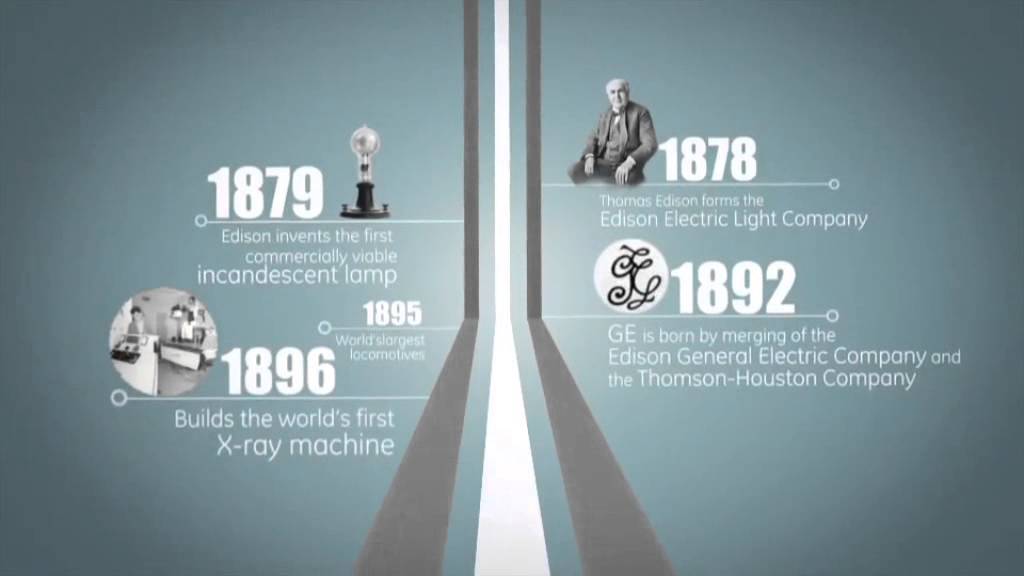
General Electric Company (GE) is an American multinational conglomerate that originally started as a New York based manufacturing company of electrical components such as lighting fixtures, lamps/bulbs, electric motors, and other lighting devices. Since the early 1900’s, GE has been primarily involved in a large number of industrial related divisions. Throughout the years, GE has always took pride in being a company of innovation. “For more than 125 years, GE has invented the future of industry.” (General Electric, 2019) Today, GE has it’s headquarters located in Boston, Massachusetts. “General Electric Company operates worldwide as a high-tech industrial company through its five industrial segments, Power, Renewable Energy, Aviation, Healthcare, Oil & Gas, and through its financial services segment, Capital.” (General Electric, 2019).
Based on your research, how does the organization score on efficiency? Defend your answer.
The idea of efficiency within an organization can apply to many aspects of a business. A company the size of General Electric has many product divisions and levels of hierarchy. The efficiency of one division can be much different than that of another based on what they are striving to achieve. However, the company as a whole is driven by strategies developed to ensure important stakeholders (i.e. investors) are satisfied. Historically, the overall drive of GE has been focused on large acquisitions, investments, and being ahead of the market through innovation of technology. “GE’s future was an unlimited supply of large, interesting companies to buy at fair prices, delivering seemingly endless growth possibilities along with operational results.” (Schrager, 2019) With this being said, GE’s focus was more about diversified company growth rather than efficiency. I would give GE a 2 out 5 for an efficiency rating. However, in recent years the world has looked very different for GE’s success and future outlook. Many of GE’s divisions were not performing well and 2017 stock prices kept falling.
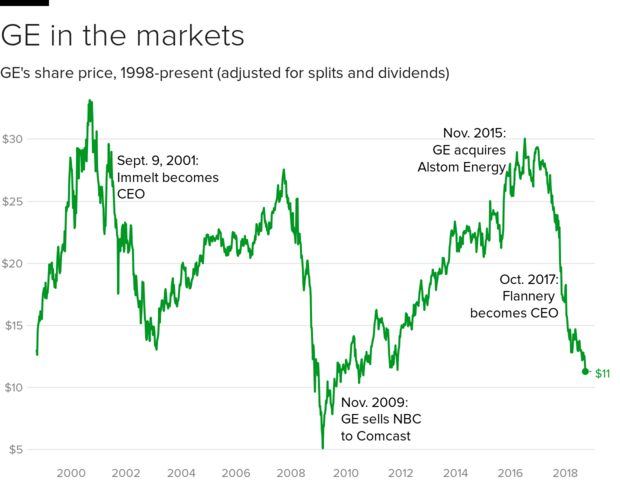
“GE increasingly seems to be in crisis mode, with the need for swift execution on cost cutting to offset continued declines in the global power market.” (Layne, 2018) Investors and GE’s top management were reluctant to change their future strategies but knew something must be done. GE’s most recent CEO (Lawrence Culp) is very focused on the future of the company, “particularly in implementing new lean-management techniques, which emphasize continuous improvements and cost reductions.” (Root, 2019) GE certainly recognizes that in order to survive the future, they must rethink how they manage their businesses at all levels.
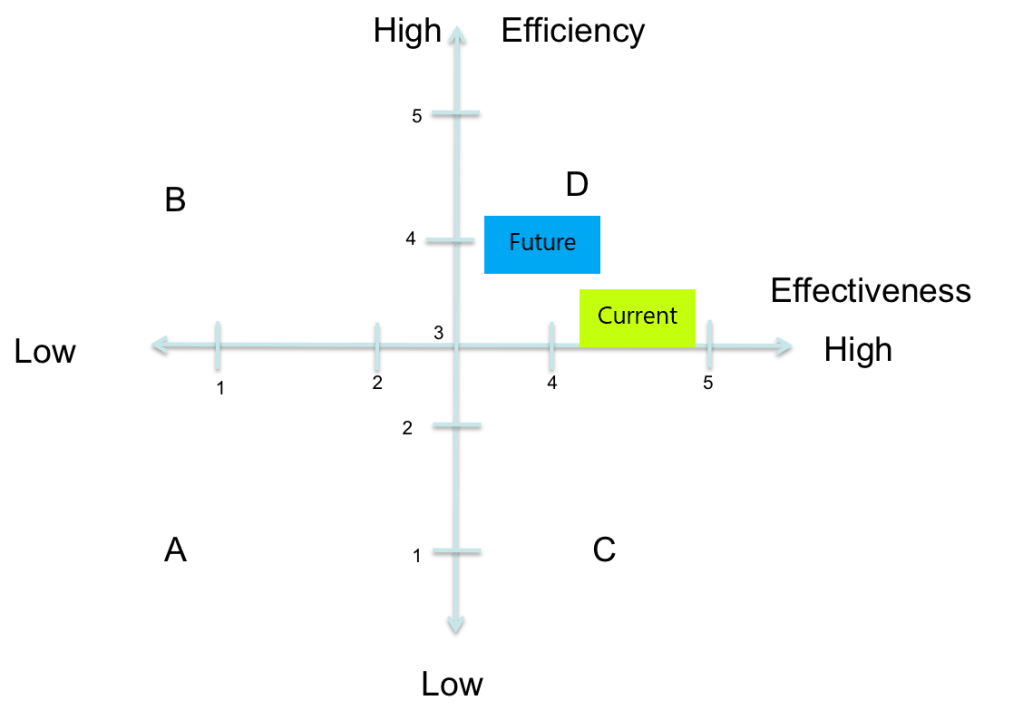
I feel that GE’s new direction will be more focused on efficiency than past years. My overall efficiency rating for GE is 3 out of 5.
Based on your research, how does the organization score on effectiveness? Defend your answer.
General Electric has always been a company that measures effectiveness through the “strategic constituents approach.” (Daft, 2016) Key stakeholders such as investors, owners, and customers are who ultimately define success for GE. The original founding owners of the company paved the way on establishing long-term goals centered around innovation, inventions, and technological advancement. These goals are still the company’s main focus today. “After a century at the forefront of industrial manufacturing, GE is transforming its portfolio of businesses to continue that pioneering leadership in the new technological era.” (General Electric, 2109) GE is striving to become a conglomerate that is less complex but still motivated to increase growth across their different divisions. GE is also focused on ensuring that their customers are fulfilled and that the company remains driven towards achieving results. “High effectiveness in satisfying business needs and customer expectations is a criterion that managers use in evaluating business performance at General Electric Company.” (Thompson, 2017) This gives GE an edge over many of their larger competitors.
GE’s current stock price ($9.34) is certainly nothing to write home about. However, GE is still figuring out how to best position their business for the future. GE appears to be more flexible on how they can manage market changes without redefining their overall strategies of innovation and technological advancement. This makes me believe that they are still very focused on effectiveness. My overall effectiveness rating for GE is 4.5 out of 5.
Where would the organization like to be on the graph? Why? How do you know?
GE would like to eventually be in quadrant D of the graph. This is primarily due to the realization that maintaining their historic drive towards effectiveness will now allow complete fulfillment of their company goals (and they realize this). The world’s market is always changing and unpredictable, GE becoming more efficient will offset much of the uncertainty of the future. This efficient mentality coupled with their strong foundation based on effectiveness will prop them for future success and longevity.
Does the current positioning of the organization correspond to its vision and mission statements? Support your answer.
GE does not necessarily have an all inclusive vision statement traditional to what we may see in many organizations. Rather, GE has a vision outlined as a company goal, “Our goal is to run more empowered, accountable businesses that are in the best possible position to create value for their customers.” (General Electric, 2019) GE’s current positioning towards meeting this vision is heading in the right direction. They have a new CEO that appears to be genuine and focused towards meeting the expectations of all key stake holders. What once use to be a very robust company built on effectiveness is now an organization that also understands the benefits of efficiency. I believe GE’s current positioning based on efficiency and effectiveness directly corresponds to their vision.
References
About us. (2019, September 14). Retrieved from General Electric: https://www.ge.com/about-us
2018 Annual Report. (2019, September 14). Retrieved from General Electric: https://www.ge.com/investor-relations/annual-report
Investor Relations. (2019, September 14). Retrieved from General Electric: https://www.ge.com/investor-relations/sites/default/files/ge_webcast_10Q_07312019.pdf
Daft, R. (2016). Organization Theory & Design. (12th ed.). Boston, MA: Cengage Learning.
Layne, R. (2018, October 1). Lawrence Culp, new GE CEO, faces tall task reviving aging conglomerate. Retrieved from CBS News: https://www.cbsnews.com/news/lawrence-culp-new-ge-ceo-faces-tall-task-reviving-aging-conglomerate/
Root, A. (2019, August 1). GE CEO Larry Culp on the Company’s Turnaround, Boeing, and China. Retrieved from the Barron’s: https://www.barrons.com/articles/general-electric-ceo-larry-culp-speaks-out-on-the-turnaround-china-and-boeing-51564588114
Schrager, J. (2019, August 14). Three strategy lessons from GE’s decline. Retrieved from Chicago Booth Review: https://review.chicagobooth.edu/strategy/2019/article/three-strategy-lessons-ge-s-decline
Thompson, A. (2017, October 20). General Electric’s (GE) Organizational Culture for Customer-Centric Simplification. Retrieved from Panmore Institute: http://panmore.com/general-electric-ge-organizational-culture-customer-centric-simplification


 Josh's (Org. Therory) Blog
This is very good. You use a triangulation of support and rationale to justify your responses. You will receive 20 out of 20 possible points on this assignment. Please let me know if I could use it as an example for future classes. Keep up the good work!
LikeLike
Thank you! I have no problem with you using this as an example.
LikeLike
Great, thanks!
LikeLike